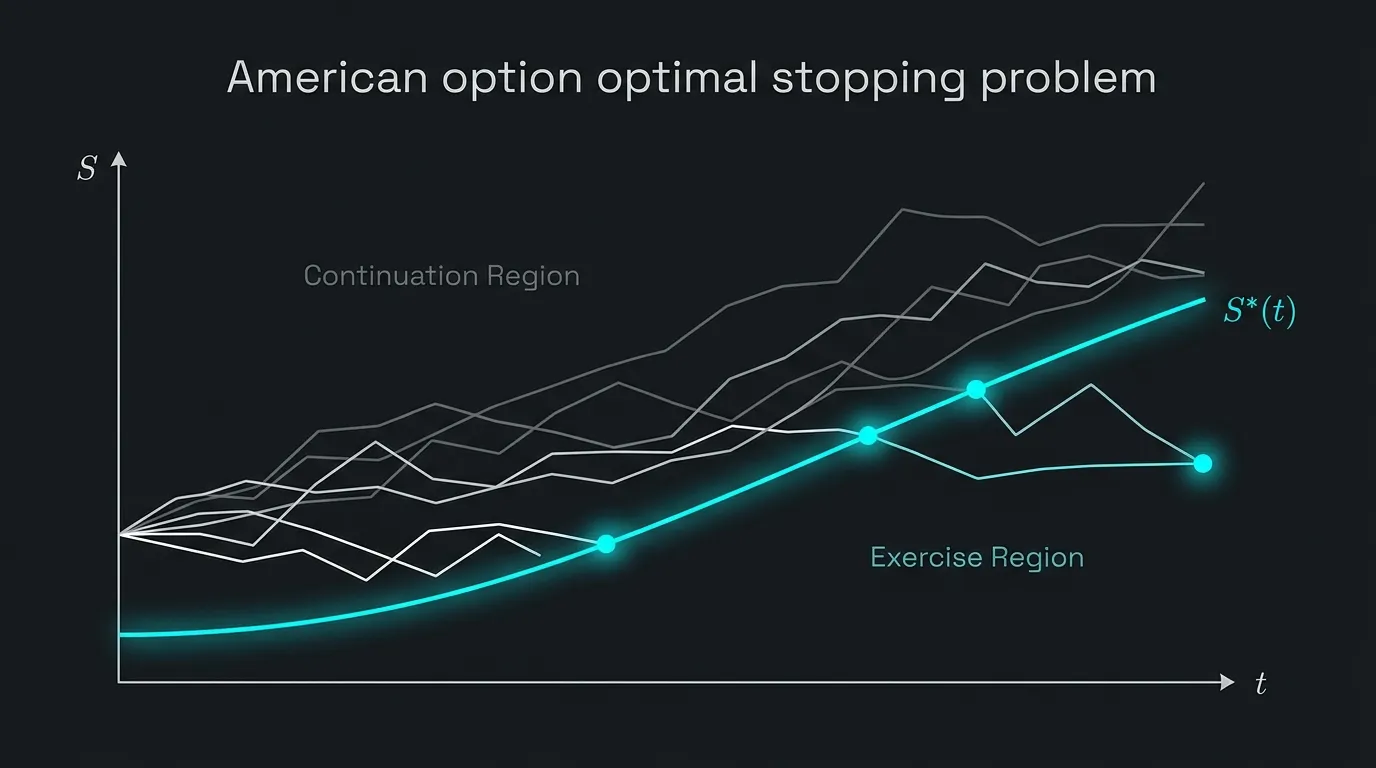
The American Option Problem: Why Early Exercise Has No Closed Form
The previous post showed what Monte Carlo can do for path-dependent European options. Before showing what it can do for American options — the most common derivative structure in the world — this post lays the foundation.
An American option is not just a European option with extra flexibility. It is a fundamentally different mathematical object. Understanding why requires unpacking three ideas: the optimal stopping problem, the free boundary, and why these lead to an equation that has no clean closed-form solution.
This is the first post in a four-part mini-series on American option pricing methods. The series builds from the theory here through tree methods, PDE solvers, and Monte Carlo.
Every American option pricing method is, at heart, a way to find the free boundary. The methods differ only in how they search for it.
Contents
The One-Decision vs. Infinite-Decisions Problem
A European option gives you exactly one decision.
At expiry , you look at the stock price . If the option is in the money, you exercise. Otherwise you let it expire. One date, one choice.
An American option gives you a decision at every moment between purchase and expiry. At each instant, the holder can ask:
Is it better to exercise now and take the cash, or to wait?
For a put option with strike , exercising at time yields immediately. Waiting might yield more — or might not. The difficulty is that the answer depends on what happens to the stock in the future, which is unknown.
This is an optimal stopping problem: choose the stopping time that maximises expected discounted payoff:
The supremum is over all stopping times in — all ways of deciding, at each moment, based on information available up to that moment. This is a clean mathematical statement. It does not obviously suggest how to compute the answer.
Why American Calls Are Easy, American Puts Are Hard
Before going further, a clarifying detour.
Intuitively, an American call should be worth more than a European call — more flexibility means more value. And it is worth at least as much.
But Robert Merton proved that for a non-dividend-paying stock, the American call is never optimally exercised early. The American and European calls have the same price.
The argument is elegant. If you exercise a call early, you receive and give up the option. But you could instead sell the option for its market price, which is at least because of time value. It is always better to sell than to exercise early — you keep the option value of not having to pay the full strike immediately.
For dividends this breaks down: if the stock pays a large dividend tomorrow, the ex-dividend price drop makes early exercise attractive. But for the standard non-dividend American call, early exercise never pays.
The American put is the interesting case.
The American call on a non-dividend-paying stock is worth the same as a European call. The interesting American option is the put.
Why would you exercise a put early? Consider a put with strike on a stock that has fallen to . Exercising gives you today, which you can invest at the risk-free rate.
Alternatively, you hold the option. But how much further can a stock at 5 fall? The maximum additional gain is (if the stock goes to zero). The time value of the intrinsic value 95 is meaningful. At high enough rates, and deep enough in-the-money, the value of the 95 today outweighs the remaining downside optionality.
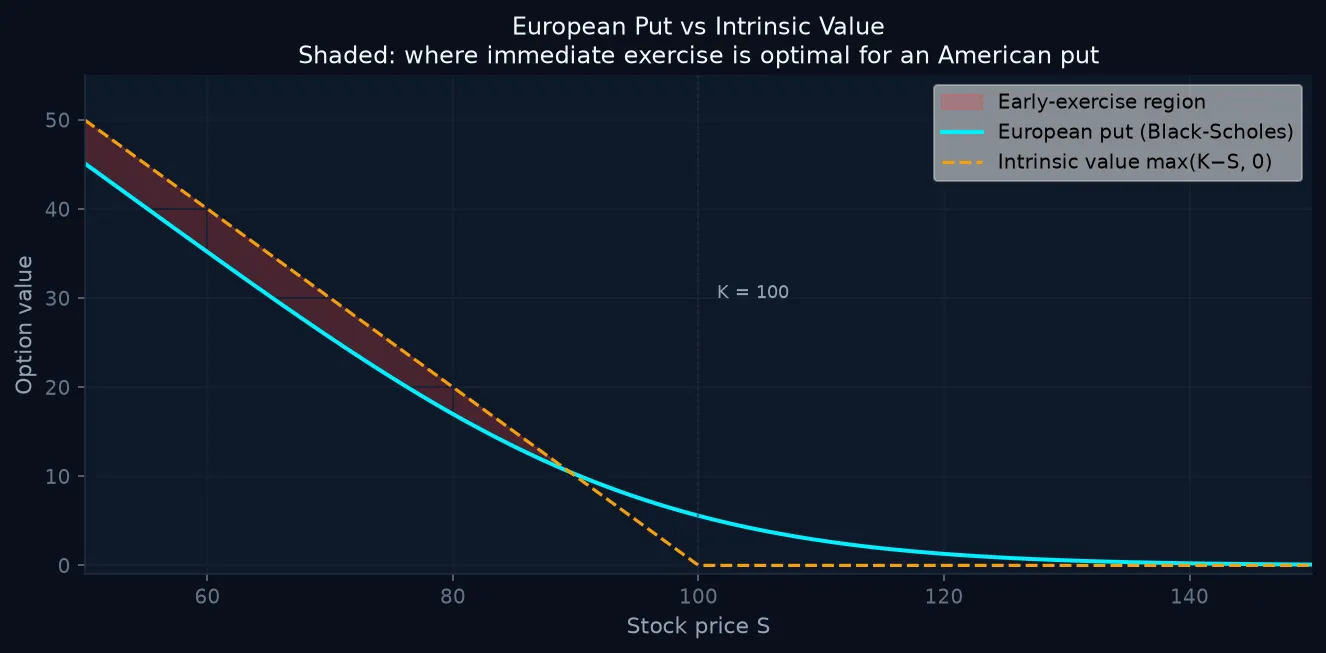
The European put can fall below intrinsic value because the holder is forced to wait. The American put cannot — you can always exercise. The gap between the two is the early exercise premium.
The Free Boundary
The early exercise question divides the state space into two regions:
- Continuation region: . Holding on is worth more than exercising. Wait.
- Exercise region: . The option is worth exactly its intrinsic value. Exercise immediately.
These two regions are separated by a curve called the free boundary or critical stock price. For an American put:
- If : hold the option.
- If : exercise immediately.
- At : the two decisions are exactly equivalent.
The boundary is not fixed — it changes over time. As expiry approaches, the time value of the option shrinks, and the threshold for early exercise rises. At expiry , the boundary reaches (it's always optimal to exercise any ITM put at expiry).
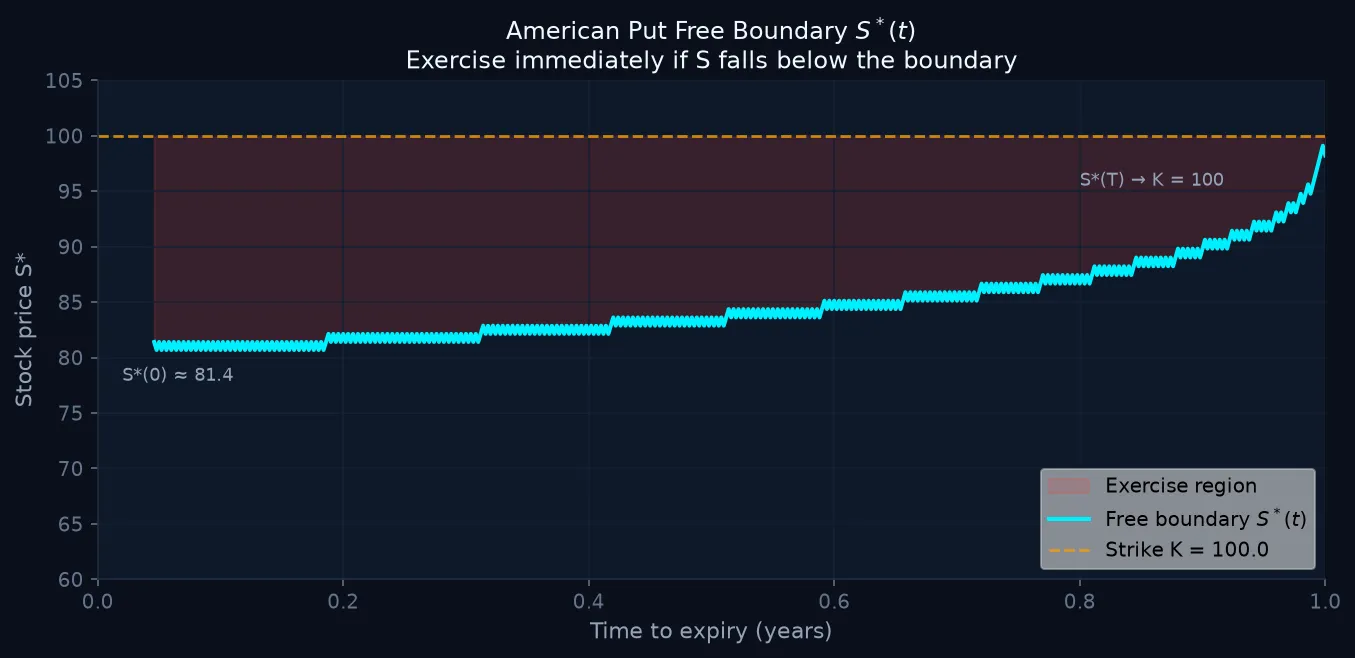
The free boundary is the central unknown of American option pricing. Every method in this series — binomial trees, finite differences, Monte Carlo — is, at heart, a way to find this boundary.
The Mathematical Framework
Optimal Stopping and the Snell Envelope
Let be a risk-neutral probability space with filtration . The American put value at time is:
where is the set of all stopping times in .
This is a Snell envelope problem: the discounted option price is the smallest supermartingale that dominates the discounted payoff process . The optimal stopping time is:
i.e., the first time the option's continuation value equals its exercise value.
Linear Complementarity Problem (LCP)
Under the Black-Scholes model, the American option satisfies a linear complementarity problem — a PDE with an inequality constraint:
with the complementarity condition: both inequalities cannot be strict simultaneously:
What this says in plain language:
- In the continuation region ( ): the Black-Scholes PDE holds with equality. The option evolves exactly as if it were European.
- In the exercise region ( ): the PDE is inactive. The option is worth its intrinsic value.
- On the free boundary ( ): both conditions hold simultaneously.
Smooth Pasting
At the free boundary, two conditions must hold:
- Value matching:
- Smooth pasting:
The smooth pasting condition says the derivative of the option value equals the derivative of the payoff at the boundary. This is not imposed — it follows from the optimality of the stopping time. If the derivative were not continuous at the boundary, a holder could improve their expected payoff by adjusting the exercise threshold slightly.
Why There Is No Closed Form
For European options, the pricing formula follows from solving the Black-Scholes PDE with a fixed terminal condition . The PDE has a fixed boundary, and the solution is a known integral that evaluates to the Black-Scholes formula.
For American options, the PDE is coupled to the free boundary — and the free boundary is unknown. To solve the PDE, you need to know the boundary. To find the boundary, you need the solution. This circular dependency is the core difficulty.
The early exercise premium has been characterised as an integral involving the free boundary:
where is the standard Black-Scholes coefficient with the strike replaced by the boundary value . This is the decomposition of Carr, Jarrow, and Myneni (1992). It is exact, but not a closed form — the integral requires knowing the free boundary at every future time , which is itself an unsolved function.
This is why American options need numerical methods. The next three posts each take a different approach:
- Part 2 — Binomial trees: discretise time and work backward through a lattice.
- Part 3 — Finite differences: discretise the PDE on a grid and solve the LCP with PSOR.
- Part 4 — Longstaff-Schwartz: simulate paths forward, regress continuation values, decide backward.
The Early Exercise Premium in Practice
How large is the premium for typical parameters?
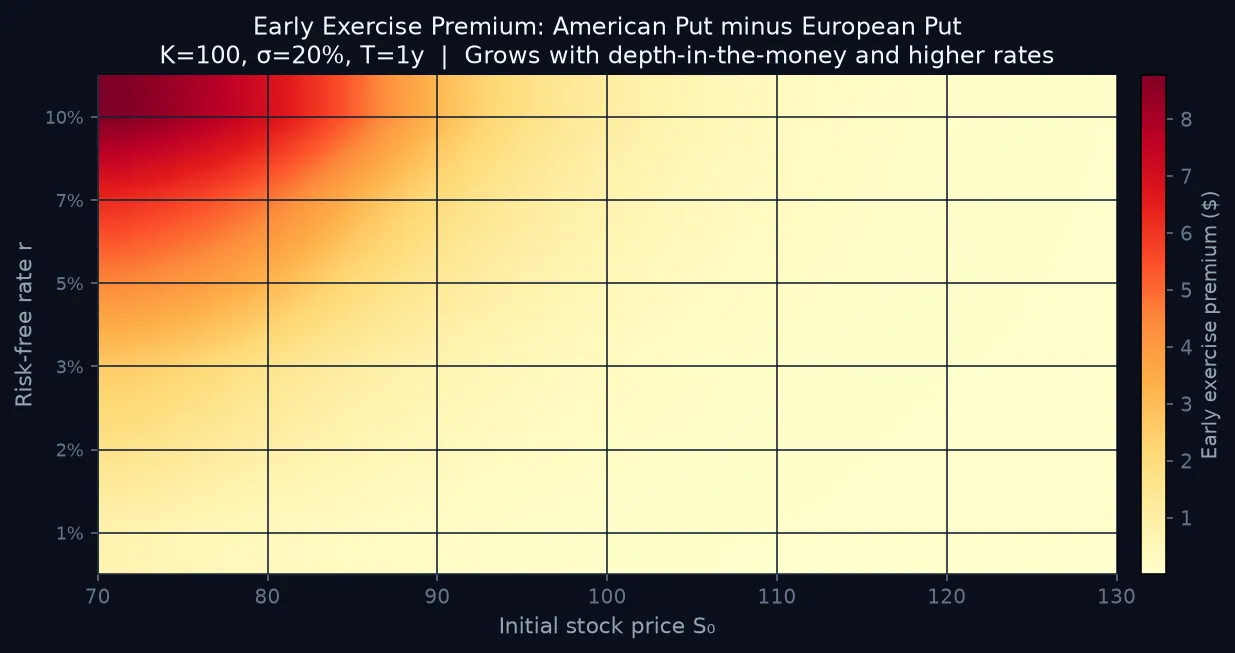
Two patterns stand out:
Higher rates → larger premium. When rates are high, the present value of receiving today exceeds the expected value of waiting. At , the premium for an at-the-money put is roughly twice what it is at .
Deeper in-the-money → larger premium. At with , the intrinsic value is . The European put may be worth less than in high-rate environments — the holder is forced to wait for a payoff they could collect immediately. The American put always commands at least its intrinsic value.
For zero rates, the American and European puts are identical. The early exercise premium is driven by the risk-free rate, the option's moneyness, volatility, and time to maturity; if the risk-free rate is zero, the premium vanishes entirely.
What Comes Next
The free boundary is an awkward object to work with. You cannot write it down in closed form. You cannot evaluate it analytically. Every numerical method in this series computes an approximation of it.
The approximation can be quite good — good enough for trading and risk management. But the boundary is always there, lurking behind the computation, making American option pricing harder than European option pricing.
Next: Binomial Trees for American Puts The most direct way to compute the boundary is to work backward through a discrete lattice. The CRR binomial tree does this exactly — within the tree's resolution.
Companion Notebook
The Python notebook for this post is available for download: american-option-problem.ipynb. It includes:
- European put vs intrinsic value chart
- Free boundary extraction from a 500-step CRR tree
- Early exercise premium surface (stock price × interest rate grid)
- Exercises for exploring the boundary under different parameters
Previous Posts in This Thread
- Monte Carlo Option Pricing: When Closed Forms Stop Helping introduces path-dependent options and the Monte Carlo pricing loop.
- Black-Scholes Without the Magic derives the PDE and explains where closed forms come from.
References
- Paul Samuelson, "Rational Theory of Warrant Pricing", Industrial Management Review, 1965. (H. P. McKean's appendix contains the first analysis of the American put free boundary.)
- Robert C. Merton, "Theory of Rational Option Pricing", Bell Journal of Economics, 1973.
- Peter Carr, Robert Jarrow, and Ravi Myneni, "Alternative Characterizations of American Put Options", Mathematical Finance, 1992.
- Lionel W. MacMillan, "Analytic Approximation for the American Put Option", Advances in Futures and Options Research, 1986.
Get in Touch
Building option pricing models, studying for the CQF, or exploring quantitative finance fundamentals?
Connect with me:
- 📧 Email: [email protected]
- 🐦 Twitter/X: @TheDataGuyPro
- 💼 LinkedIn: Muhammad Afzaal
- 💻 GitHub: @mafzaal
- 🎥 YouTube: @TheDataGuyPro
- 🎧 Podcast: TheDataGuy Show
Whether you're exploring American option theory, building pricing infrastructure, or learning quantitative finance from the ground up, I'd love to hear from you!