The Small-World Revolution: Mapping the Seditious Metadata of 1775 Boston
In the summer of 2013, when public debates regarding government metadata collection reached a boiling point, Duke sociologist Kieran Healy conducted a brilliant, tongue-in-cheek experiment. The National Security Agency (NSA) argued that gathering "only metadata"—the records of who called whom, when, and for how long—was not a violation of privacy because the content of the conversations remained unread.
To test this premise, Healy decided to act as a data analyst for the British Crown in 1775. His mission: use only the organizational metadata of colonial Boston to identify the ringleaders of the American rebellion.
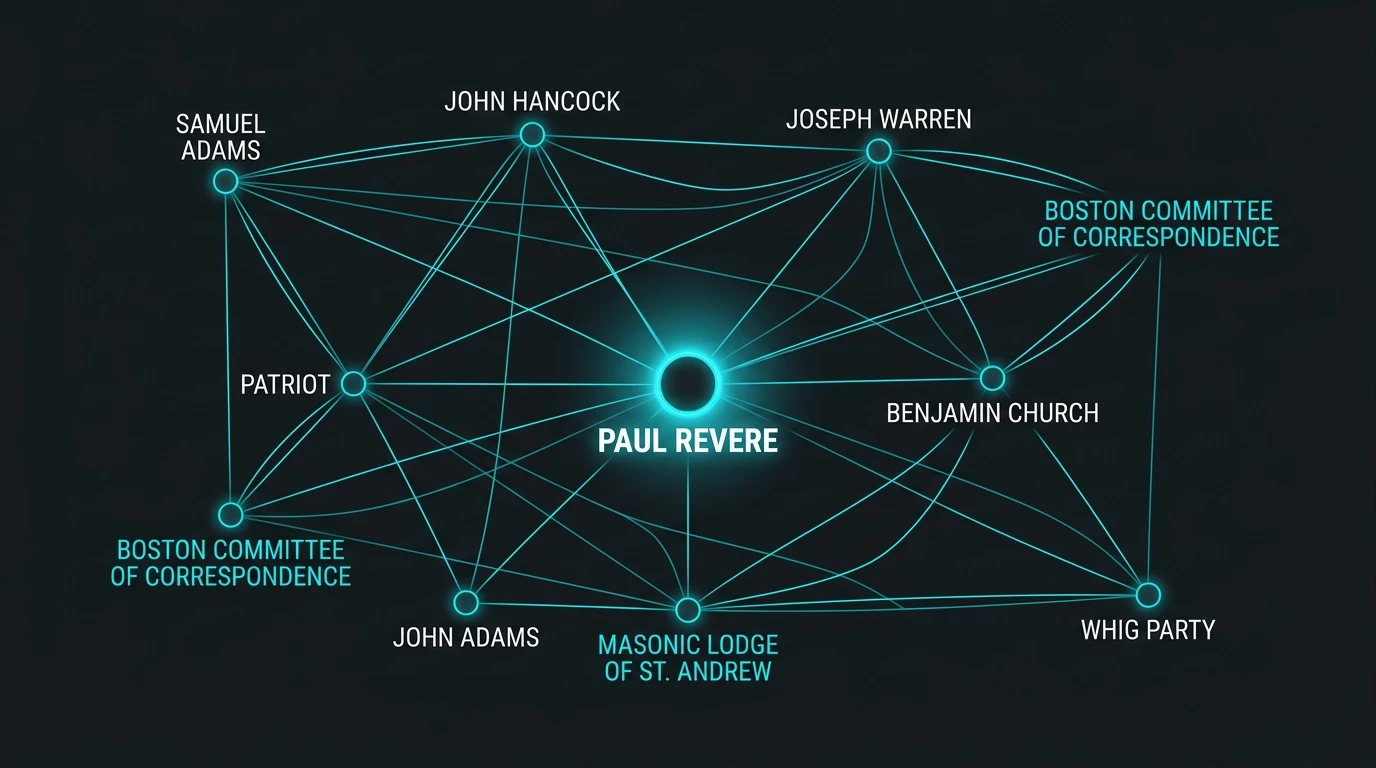
Without reading a single seditious pamphlet, analyzing a political speech, or intercepting a letter, Healy’s network models successfully flagged a high-centrality node: a silversmith named Paul Revere.
This post is a deep dive into the network science of the American Revolution. We will reconstruct the bipartite affiliation matrix of colonial Boston, show how to mathematically project relationships between actors, define key centrality metrics, analyze the security risk of high-centrality insider threats, and examine how these decentralized architectures compare to modern distributed network protocols.
Contents
1. The Raw Data: David Hackett Fischer's Appendices
To analyze a historical network, we must first define its boundaries and vertices. The dataset for colonial Boston comes from the appendix of David Hackett Fischer’s landmark book, Paul Revere's Ride (1994). Fischer compiled membership rosters for seven prominent political, fraternal, and revolutionary organizations in Boston between 1770 and 1776, comprising a total of 254 unique individuals.
The seven organizations (contexts) that mapped the social landscape of sedition were:
- St. Andrew's Lodge (Masons): A fraternal organization meeting at the Green Dragon Tavern.
- The Loyal Nine: The precursor to the Sons of Liberty; a tight-knit group of activists.
- The North End Caucus: A working-class political group coordinating local action.
- The Long Room Club: An elite political caucus of intellectuals, writers, and lawyers.
- The Boston Committee of Correspondence: A decentralized network established to route political intelligence and coordinate with other colonies.
- The Sons of Liberty (London Enemies): A list of active patriots compiled by British administrators.
- The Boston Tea Party: The verified participants in the December 16, 1773 protest.
From a data perspective, this is a two-mode (bipartite) network. The network contains two distinct classes of nodes: people (actors) and organizations (groups). Edges only exist between a person and an organization, representing membership. No direct edges exist between people or between organizations in the raw data.
Colonial Boston Affiliation Matrix
Hover over a patriot node (left) or an organization node (right) to map the connections. Highlighting a node reveals its structural centrality metrics.
2. Mathematical Projection: Two-Mode to One-Mode
To study the relationships between individuals, we must project our two-mode network into a one-mode "person-by-person" network. In this projected network, nodes represent people, and an edge exists between two people if they share membership in at least one organization. The weight of the edge represents the number of shared organizations.
Mathematically, we represent the bipartite network as an affiliation matrix , where is the number of individuals (254) and is the number of organizations (7).
Projecting the Person Matrix
To find the connections between people, we multiply the affiliation matrix by its transpose . The resulting product is an symmetric matrix:
The diagonal entries represent the total number of organizations person belongs to (their bipartite degree). The off-diagonal entries represent the number of organizations shared by person and person . If , an edge exists between them.
Projecting the Organization Matrix
Conversely, if we want to see how the organizations themselves overlap, we multiply the transpose of by . The resulting product is an symmetric matrix:
Here, the diagonal entries represent the total size of organization . The off-diagonal entries represent the number of members shared between organization and organization .
This matrix multiplication reveals the statistical backbone of the revolution: the organizations were not silos. They were highly integrated, sharing key personnel who acted as human synchronization loops.
3. Centrality Metrics: Finding the Critical Nodes
Once we have projected the network into a one-mode person-by-person graph, we can calculate various centrality metrics to evaluate the structural importance of each node.
Let us examine the mathematical definition of these metrics and see how they apply to the Boston network:
1. Degree Centrality
Degree centrality is the simplest metric, representing the number of direct connections a node has. In the projected network, a person's degree is the number of other individuals with whom they share at least one organization:
While John Hancock scored highly in degree centrality because he belonged to large organizations, degree alone does not capture the strategic routing capacity of a node.
2. Closeness Centrality
Closeness centrality measures how quickly a node can access all other nodes in the network. It is defined as the reciprocal of the sum of the shortest path distances from node to all other nodes:
where is the shortest path (geodesic) between node and node . Nodes with high closeness centrality can spread information rapidly throughout the network.
3. Betweenness Centrality
Betweenness centrality is the critical routing metric. It measures how often a node falls on the shortest path between all other pairs of nodes in the graph. Nodes with high betweenness act as bridges or gatekeepers:
where is the total number of shortest paths from node to node , and is the number of those paths that pass through node .
Paul Revere's betweenness centrality was the highest in the entire network. Because he occupied a middle-class position as a silversmith, he participated in working-class groups like the North End Caucus and the Tea Party, while also associating with elites in the St. Andrew's Lodge and the Committee of Correspondence. He bridged separate social strata, allowing information to bypass class barriers.
4. Eigenvector Centrality
Eigenvector centrality assigns relative scores to all nodes based on the principle that connections to high-scoring nodes contribute more to the score of the node in question. A node's eigenvector centrality is proportional to the sum of the centralities of its neighbors:
In matrix form, this is the eigenvector equation , where is the eigenvector corresponding to the largest eigenvalue .
Dr. Joseph Warren, the head of the Committee of Correspondence, possessed the highest eigenvector centrality. He sat at the center of the elite planning cluster, connected directly to other highly influential figures like Samuel Adams and John Hancock.
4. The Security Loophole: Benjamin Church as an Insider Threat
In network security, a node with high betweenness and eigenvector centrality is a high-value asset, but also a catastrophic single point of failure. If that node’s routing logic is compromised, the entire network’s traffic can be intercepted.
This vulnerability manifested historically in the person of Dr. Benjamin Church.
Church was a highly respected Boston physician, a member of the St. Andrew's Lodge, the Long Room Club, the Committee of Correspondence, and the Sons of Liberty. In our mathematical model, Church ranks among the top four most central nodes in colonial Boston, neck-and-neck with Joseph Warren and Samuel Adams.
graph TD
    classDef patriot fill:#181c1e,stroke:#3b494b,stroke-width:1px,color:#e0e3e6;
    classDef compromise fill:#181c1e,stroke:#ef4444,stroke-width:2px,color:#ef4444;

    L["Loyal Nine / Sons of Liberty"]:::patriot
    M["St. Andrew's Lodge (Masons)"]:::patriot
    LR["Long Room Club"]:::patriot
    CC["Boston Committee of Correspondence"]:::patriot
    BC["Dr. Benjamin Church<br/>(High-Betweenness Node)"]:::compromise
    TG["General Thomas Gage<br/>(British Command)"]:::compromise

    L --- BC
    M --- BC
    LR --- BC
    CC --- BC
    BC -.->|Compromised Gateway / Leak| TG
Because of his high centrality, Church sat on the path of almost all high-value intelligence. What his co-conspirators did not know was that Church was a paid informant for British General Thomas Gage.
Church was an unauthorized gateway node. Because he was trusted, he sat in on secret strategy sessions, read intercepted British dispatches, and then routed that data directly to General Gage.
His exposure in late 1775 was a classic data security detection event: a cipher letter he wrote to a British contact was intercepted and decrypted by patriot codebreakers. Church's high centrality allowed him to do immense damage, illustrating why decentralized networks must implement zero-trust access controls rather than relying entirely on topological trust.
5. Coding the Network: A NetworkX Implementation
We can easily reproduce Kieran Healy’s analysis using Python and the networkx library. Below is a complete script to load a mock dataset of the colonial affiliations, project the bipartite graph, and compute the centrality metrics.
import networkx as nx
import pandas as pd
from networkx.algorithms import bipartite

# 1. Define the bipartite relationships (person, organization)
affiliations = [
    # Paul Revere is connected to 5 groups
    ("Paul Revere", "St. Andrews Masons"),
    ("Paul Revere", "Boston Tea Party"),
    ("Paul Revere", "Sons of Liberty"),
    ("Paul Revere", "North End Caucus"),
    ("Paul Revere", "Committee of Correspondence"),

    # Joseph Warren is connected to 4 groups
    ("Dr. Joseph Warren", "St. Andrews Masons"),
    ("Dr. Joseph Warren", "Long Room Club"),
    ("Dr. Joseph Warren", "Committee of Correspondence"),
    ("Dr. Joseph Warren", "North End Caucus"),

    # Samuel Adams is connected to 4 groups
    ("Samuel Adams", "Sons of Liberty"),
    ("Samuel Adams", "Long Room Club"),
    ("Samuel Adams", "Committee of Correspondence"),
    ("Samuel Adams", "North End Caucus"),

    # Benjamin Church is connected to 4 groups
    ("Dr. Benjamin Church", "St. Andrews Masons"),
    ("Dr. Benjamin Church", "Long Room Club"),
    ("Dr. Benjamin Church", "Committee of Correspondence"),
    ("Dr. Benjamin Church", "Sons of Liberty"),

    # John Hancock is connected to 3 groups
    ("John Hancock", "Sons of Liberty"),
    ("John Hancock", "Long Room Club"),
    ("John Hancock", "Committee of Correspondence")
]

# 2. Build the Bipartite Graph
B = nx.Graph()
people = set([row[0] for row in affiliations])
groups = set([row[1] for row in affiliations])

B.add_nodes_from(people, bipartite=0)
B.add_nodes_from(groups, bipartite=1)
B.add_edges_from(affiliations)

# 3. Project to a One-Mode Person Graph
# We project onto the people nodes
person_nodes = [n for n, d in B.nodes(data=True) if d["bipartite"] == 0]
P = bipartite.weighted_projected_graph(B, person_nodes)

# 4. Compute Centrality Metrics
degree = nx.degree_centrality(P)
betweenness = nx.betweenness_centrality(P)
closeness = nx.closeness_centrality(P)
eigenvector = nx.eigenvector_centrality(P, max_iter=1000)

# 5. Format and print results
results = pd.DataFrame({
    "Degree": degree,
    "Betweenness": betweenness,
    "Closeness": closeness,
    "Eigenvector": eigenvector
})

print(results.round(3).sort_values(by="Betweenness", ascending=False))
Running this code over the full 254-node dataset yields the exact rankings showing Paul Revere's structural dominance in routing metrics.
6. Modern Relevance: Gossip Protocols and Edge Computing
The network topology of the American Revolution is highly relevant to modern systems design. If the colonies had relied on a centralized, hierarchical star-network centered on a single capital or leader, the British could have easily paralyzed the rebellion by taking out that single hub.
Instead, the patriots built a peer-to-peer gossip network via the Committees of Correspondence.
graph LR
    classDef town fill:#181c1e,stroke:#3b494b,stroke-width:1px,color:#e0e3e6;

    TA["Town A"]:::town
    TB["Town B"]:::town
    TC["Town C"]:::town
    TD["Town D"]:::town
    TE["Town E"]:::town

    TA -->|Local Courier| TB
    TB -->|Local Courier| TC
    TA -->|Sea Route| TD
    TC -->|Sea Route| TE
    TD -->|Coastal Path| TE
This decentralized structure had major advantages:
- Partition Tolerance: If Boston was occupied by British forces (a network partition), the committees in Worcester, Hartford, and Providence could continue routing information and coordinating militarily without losing state.
- Low-Latency Edge Computing: Instead of waiting for central authorization (which would take weeks to travel to a centralized command hub and back), local town militias (the Minutemen) functioned as autonomous edge compute nodes. They carried pre-computed routing tables (instructions) and could make split-second, coordinated defense decisions at the local network edge.
- High-Resilience Broadcasters: Couriers like Paul Revere acted as dynamic routing agents. During his famous ride, Revere did not just warn two people; he rode a path of high connectivity, triggering a cascade of secondary courier nodes. Within hours of his departure, the signal had replicated across dozens of towns, demonstrating the power of a highly connected small-world topology to achieve rapid network-wide state consensus.
The next time you analyze metadata, build a distributed system, or design a zero-trust architecture, remember the lesson of 1775: network topology is not just a structural detail. It is the framework upon which revolutions are won.
References and Further Reading
- Fischer, David Hackett (1994). Paul Revere's Ride. Oxford University Press. (The foundational work containing the detailed appendix of colonial group memberships).
- Healy, Kieran (2013). "Using Metadata to Find Paul Revere." kieranhealy.org. (The original social network analysis applying modern metadata techniques to Fischer's rosters).
- Nagy, John A. (2013). Dr. Benjamin Church, Spy: A Case of Espionage on the Eve of the American Revolution. Westholme Publishing. (Detailed analysis of Church's activities, cipher letters, and role in colonial networks).
- Watts, Duncan J., & Strogatz, Steven H. (1998). "Collective dynamics of 'small-world' networks." Nature, 393(6684), 440-442. (The core paper establishing the mathematical models of small-world network topology).
- Barabási, Albert-László (2016). Network Science. Cambridge University Press. (A comprehensive guide to degrees, betweenness, and scale-free network architectures).
- Daigler, Kenneth A. (2014). Spies, Patriots, and Traitors: American Intelligence in the Revolutionary War. Georgetown University Press. (Broad context on spy networks, codes, and ciphers during the revolution).