RAG Evaluation in Production: Moving Beyond Metrics for Enterprise Success
I've seen it happen more times than I can count. A team builds a brilliant Retrieval-Augmented Generation (RAG) proof-of-concept. The demos are flawless. The offline metrics—ROUGE, F1-scores, precision/recall on a static "golden" dataset—look fantastic. Everyone gets excited, and the project moves to production.
Then, silence.
Six months later, users are quietly abandoning it. Stakeholders start asking tough questions about ROI. The team is flying blind, unsure if the system is hallucinating, providing irrelevant answers, or just failing to meet user expectations. The problem? Their evaluation strategy never left the lab.
In an enterprise setting, especially when integrating RAG into critical systems like D365 or customer support portals, "good enough" on a static test set is a recipe for failure. Production is a dynamic, messy environment. Data changes, user queries evolve, and business needs shift. To succeed, you need a robust, continuous evaluation strategy that moves far beyond academic metrics and measures what truly matters: business impact.
In an enterprise setting, especially when integrating RAG into critical systems, "good enough" on a static test set is a recipe for failure.
Contents
The Problem with "Lab" Metrics
Traditional NLP metrics are designed for controlled experiments. They require a static, human-annotated dataset where you have a single "ground truth." This setup breaks down in production for several reasons:
- Stale Ground Truth: Your knowledge base (e.g., product manuals, support articles, internal policies) is constantly being updated. A static test set quickly becomes obsolete, giving you a false sense of security.
- No Concept of "Good Enough": A ROUGE score of 0.7 tells you nothing about whether the answer helped a customer resolve their issue or if it was just a well-phrased hallucination.
- Ignores the User: These metrics are completely divorced from user satisfaction. An answer can be factually correct and match the ground truth but be presented in a way that's confusing or unhelpful.
- Doesn't Measure Business Value: No offline metric can tell you if your RAG system is reducing support ticket volume or helping your sales team close deals faster.
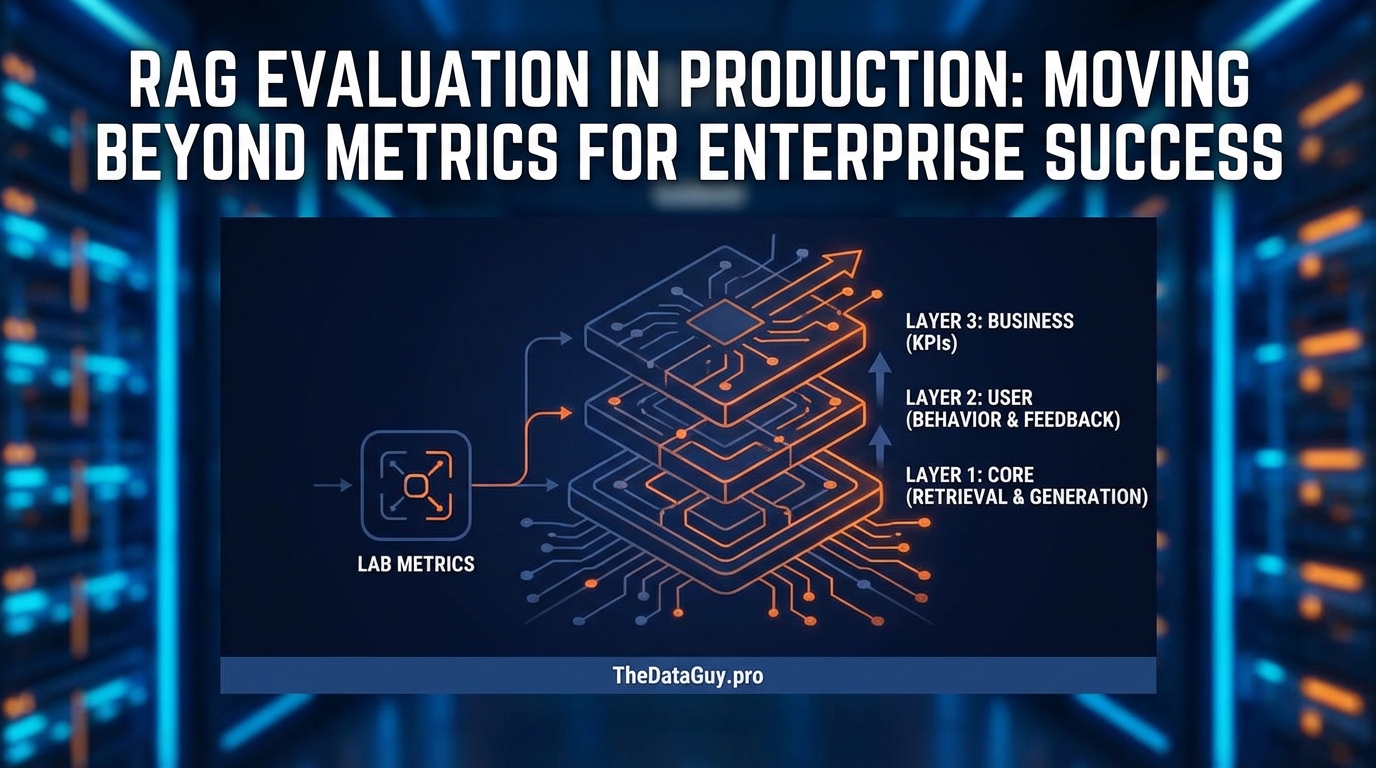
To build and maintain a successful enterprise RAG application, we need to think in layers.
A Multi-Layered Framework for Production RAG Evaluation
I approach production RAG evaluation with a three-layer model. Each layer builds on the one before it, moving from technical correctness to real-world business value.
- The Core (Quality): Is the RAG system mechanically sound? Is the retriever finding the right information, and is the generator using it faithfully?
- The User (Experience): Are users finding the system helpful? Are they engaging with it, or are they struggling?
- The Business (Impact): Is the system moving the needle on key business metrics? Is it delivering a return on investment?
Let's break down how to measure each layer.
Layer 1: The Core — Retrieval & Generation Quality
This is the foundation. If your RAG system can't reliably retrieve relevant context and generate a faithful answer, nothing else matters. The challenge is doing this at scale without a massive team of human annotators.
The solution? Using a powerful LLM to evaluate the output of your RAG system—a pattern often called "LLM-as-a-Judge." Frameworks like Ragas, TruLens, and DeepEval have popularized this, but in production, they are increasingly integrated into full trace observability platforms like Langfuse, Phoenix, or Braintrust to connect trace spans (like chunk size or retriever latency) directly with evaluation scores.
Evaluating the Retriever
Your RAG system is only as good as the context it retrieves. We focus on two key metrics:
- Context Precision: Of the documents retrieved, how many are actually relevant to the user's query? This helps you spot "noisy" retrievers that pull in junk information.
- Context Recall: Did you retrieve all the necessary documents to answer the query completely? Low recall means your answers will be incomplete, even if they are factually correct based on the limited context.
An LLM-as-a-Judge can estimate these by looking at the query and the retrieved chunks and making a judgment call on their relevance.
Evaluating the Generator
Once you have the context, the generator's job is to synthesize a useful answer. Here, we care most about:
- Answer Relevancy: Does the generated answer actually address the user's question?
- Faithfulness (or Groundedness): This is the single most important metric. Is the answer fully supported by the provided context? This is your primary defense against hallucination. An unfaithful answer is a lie, and lies destroy user trust.
To check for faithfulness, we use another LLM-as-a-Judge prompt. You provide the judge LLM with the generated answer and the original context and ask it to verify every claim in the answer against the source text.
The Crucial Prompting Detail: JSON Key Ordering
When prompting an LLM to output structured JSON (such as using OpenAI's JSON mode or structured outputs), the order of the keys in your schema matters immensely.
Because LLMs generate text token-by-token (sequentially), they cannot plan ahead. If your schema asks for the final verdict (is_faithful) first, the model must commit to a boolean decision before writing down its reasoning. This "cart before the horse" design degrades reasoning performance. By placing the reasoning key first, we force the model to write out a step-by-step verification (acting as an implicit Chain-of-Thought) before generating the final boolean verdict.
Forcing the model to write out its reasoning before the final verdict behaves as an implicit Chain-of-Thought, drastically increasing judge accuracy.
Here's a conceptual Python snippet of what this check looks like using an LLM call:
import openai

def check_faithfulness(answer, context, query):
    """
    Uses an LLM-as-a-Judge to check if the answer is grounded in the context.
    Forcing 'reasoning' first in the JSON schema enables Chain-of-Thought (CoT).
    """
    client = openai.OpenAI() # Assumes API key is set in environment

    prompt = f"""
    You are an expert evaluator. Your task is to determine if the 'Answer' is fully supported by the 'Context' provided.
    Read the 'Context' and the 'Answer' carefully. Compare each statement in the 'Answer' to the information in the 'Context'.

    Respond with a single JSON object with two keys:
    1.  "reasoning": a step-by-step logical analysis verifying if each claim in the Answer is supported by the Context.
    2.  "is_faithful": a boolean value (true if all parts of the answer are supported by the context, false otherwise).

    Query: "{query}"

    Context:
    ---
    {context}
    ---

    Answer:
    ---
    {answer}
    ---
    """

    response = client.chat.completions.create(
        model="gpt-4-turbo",
        messages=[{"role": "system", "content": prompt}],
        temperature=0.0,
        response_format={"type": "json_object"}
    )

    # In a real system, you'd parse the JSON from response.choices[0].message.content
    return response.choices[0].message.content

# Example usage with your RAG output
# generated_answer = "The system supports up to 10 users on the standard plan."
# retrieved_context = "Our standard plan includes features A, B, and C. The enterprise plan allows for unlimited users."
# user_query = "How many users on the standard plan?"

# result = check_faithfulness(generated_answer, retrieved_context, user_query)
# print(result)
# Expected Output (conceptual):
# {
#   "reasoning": "The answer states the standard plan supports 10 users, but the context does not contain this information. The context only mentions the enterprise plan has unlimited users.",
#   "is_faithful": false
# }
Mitigating Judge Bias and Production Economics
While the LLM-as-a-judge pattern is powerful, you cannot trust it blindly in production for two reasons: bias and cost.
- Systematic Biases: LLMs are prone to position bias (favoring whichever context chunk or candidate answer appears first), verbosity bias (grading longer answers higher), and self-preference bias (gpt-4 favoring gpt-4 responses). To mitigate this, you must calibrate your LLM judge against human expert labels, adjusting your prompts until you achieve a correlation score of . You can also swap the order of inputs randomly to cancel out position bias.
- The Economics of Scale: Running a frontier LLM (like GPT-4 or Claude 3.5 Sonnet) as a judge on 100% of live traffic is financially and computationally unviable. Instead, implement a Cascade Evaluation architecture:
- Run-time Guardrails: Use lightweight, fast classifiers (like Llama-Guard or simple vector comparisons) to block critical failures inline.
- Asynchronous Sampling: Route 5–10% of production traffic logs to an offline queue where your thorough LLM-as-a-Judge evaluates quality metrics.
- CI/CD Regression Suite: Run your comprehensive LLM-as-a-Judge against a golden benchmark dataset before merging any code or prompt changes.
Layer 2: The User — Behavior & Feedback Metrics
A technically perfect answer is useless if users don't find it helpful. This layer is about measuring user satisfaction through their actions.
Implicit Feedback Signals
User behavior is often more honest than a survey. Track these signals:
User behavior—such as re-query rates, session abandonment, and copy-paste events—is often a far more honest signal of satisfaction than a survey.
- Click-Through Rate (CTR): If your RAG system suggests answers or sources, are users clicking them? Low CTR is a red flag.
- Re-query Rate: Does the user ask the same question again, perhaps with different wording, immediately after getting an answer? This signals the first answer was a failure.
- Session Abandonment: Does the user simply leave after getting an answer? Or do they continue their task?
- Copy-Paste Events: Are users copying the answer? This is a strong positive signal.
Explicit Feedback Mechanisms
Don't be afraid to ask for feedback directly, but make it frictionless.
- Thumbs Up / Thumbs Down: This is the simplest and most effective mechanism. Every answer should have it.
- "Flag for Review": For critical applications, give users a way to flag answers they believe are incorrect or harmful. This creates a high-priority queue for human review.
This user feedback is invaluable. A spike in "thumbs down" ratings is a leading indicator of a problem, and the flagged answers become the perfect source material for creating new, high-quality test cases.
Layer 3: The Business — Tying RAG to KPIs
This is where you justify the existence of your RAG system to the business. You must connect the dots between your system's performance and the Key Performance Indicators (KPIs) your stakeholders care about.
The best way to do this is with A/B testing. You can't just deploy a RAG system and claim credit for a company-wide metric improvement. You have to prove causality.
You can't just deploy a RAG system and claim credit for improvement. You must prove causality using A/B testing against business KPIs.
A D365 Customer Service Example
Imagine you've integrated a RAG bot into the D365 Customer Service agent desktop to help agents find information faster.
- Hypothesis: Our new RAG system (Variant B) will reduce the time agents spend searching for answers compared to the old knowledge base (Variant A).
- A/B Test Setup: Route 50% of agents to the old system and 50% to the new RAG-powered system.
- Metrics to Measure:
- Average Handle Time (AHT): How long does it take an agent to resolve an issue?
- First Contact Resolution (FCR): Is the issue solved on the first try?
- Ticket Escalation Rate: Are fewer tickets being escalated to senior support?
- Result: After running the test for a few weeks, you can say with statistical confidence, "The RAG system reduced AHT by 15% and cut escalation rates by 10%," which translates directly into cost savings.
This is the kind of language that gets you more budget and builds trust with business leaders.
Architecting for Continuous Evaluation
You can't just bolt this on at the end. You need to design your RAG system with observability and evaluation in mind from day one.
A high-level evaluation architecture includes:
- Comprehensive Logging: Log every query, the retrieved context, the final prompt, the generated answer, and any user feedback signals. Stream this data to a central data lake or warehouse.
- Automated Evaluation Service: A scheduled service that pulls a sample of the logged data and runs it through your "LLM-as-a-Judge" pipeline for core quality metrics (faithfulness, relevancy, etc.).
- A/B Testing Framework: A feature flagging or traffic splitting mechanism that allows you to route users to different versions of your RAG pipeline (e.g., new model, different prompt, updated retriever).
- Monitoring & Alerting: A dashboard (e.g., in Grafana, Datadog) that visualizes all three layers of your evaluation metrics. Set up alerts for sudden drops in faithfulness, spikes in negative user feedback, or regressions in A/B test KPIs.
Here's a simple diagram of how these components fit together:
graph TD
    subgraph "Live Traffic"
        UserQuery --> AB_Orchestrator{A/B Test Orchestrator}
        AB_Orchestrator -- "Variant A" --> RAG_A[RAG Pipeline A]
        AB_Orchestrator -- "Variant B" --> RAG_B[RAG Pipeline B]
    end

    subgraph "Data & Feedback Collection"
        RAG_A --> Logger[Request/Response Logger]
        RAG_B --> Logger
        RAG_A --> FeedbackSvc[User Feedback Service]
        RAG_B --> FeedbackSvc
    end

    subgraph "Offline Evaluation & Monitoring"
        Logger --> DataLake[(Data Lake)]
        FeedbackSvc --> DataLake
        DataLake --> EvalService{Automated Evaluation Service}
        EvalService -- "Faithfulness, Relevancy, etc." --> Monitoring[Monitoring & Alerting Dashboard]
        AB_Orchestrator -- "Business KPIs (AHT, FCR)" --> Monitoring
    end

    subgraph "Continuous Improvement Loop"
        Monitoring -- "Alert: Low Faithfulness" --> HumanReview[Human Review Queue]
        HumanReview -- "Fix & Add to Golden Set" --> RAG_Config[Update RAG Config / Data]
    end
This creates a powerful feedback loop where production performance directly informs development priorities.
Key Takeaways
Building an enterprise-grade RAG system is a marathon, not a sprint. A successful launch is just the beginning.
- Ditch the Lab Mentality: Static, offline metrics are insufficient for production. They can be dangerously misleading.
- Think in Layers: Evaluate your system on its core technical quality, user experience, and tangible business impact.
- Automate Quality Checks: Use the "LLM-as-a-Judge" pattern to continuously monitor for hallucinations (faithfulness) and relevance at scale.
- Listen to Your Users: Your users' implicit actions (clicks, re-queries) and explicit feedback (thumbs up/down) are your most valuable evaluation data.
- Prove Your Worth: Use A/B testing to directly connect your RAG system's performance to the business KPIs that matter to your stakeholders.
- Build for Observability: Architect your system from the ground up to log everything and make evaluation a continuous, automated process.
By adopting this production-first evaluation mindset, you can move from building a cool tech demo to deploying a reliable, valuable, and trusted AI asset for your enterprise.
Get in Touch
Robust evaluation is the difference between a flashy demo and a mission-critical enterprise asset. Want to discuss RAG in production or explore consulting?
Connect with me:
- 📧 Email: [email protected]
- 🐦 Twitter/X: @TheDataGuyPro
- 💼 LinkedIn: Muhammad Afzaal
- 💻 GitHub: @mafzaal
- 🎥 YouTube: @TheDataGuyPro
- 🎧 Podcast: TheDataGuy Show