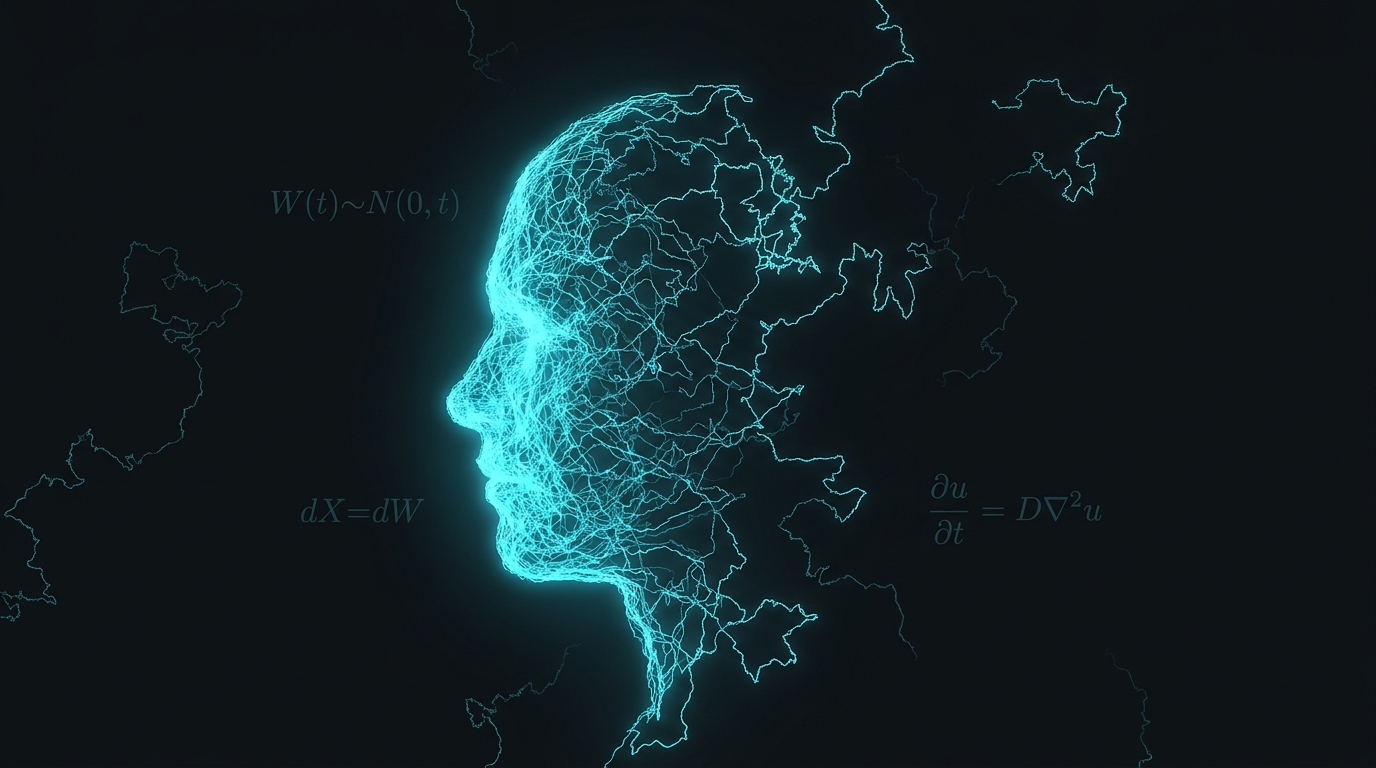
The Unstoppable Mind: Norbert Wiener and the Mathematics of Continuous Randomness
Cambridge, Massachusetts. 1940.
A portly, heavily bearded figure shuffles down the corridors of MIT's mathematics department, nearly colliding with a student. He stops, peers through thick glasses, and asks: "Young man — which way was I walking when you saw me?"
The student, startled, points north.
"Good," says the professor. "Then I've already had lunch."
The story is almost certainly apocryphal. But it endured because it felt true. Norbert Wiener was, by all accounts, a man whose mind was so completely elsewhere that the physical world — including his own body, his own location, his own daily schedule — was a persistent inconvenience. He had graduated from university at fourteen. He had a Harvard PhD at eighteen. He had, somewhere along the way, built the mathematical framework for continuous randomness that would underpin stochastic calculus, options pricing, modern signal processing, and the theoretical foundation of machine learning.
He had also predicted, with uncomfortable accuracy, that the machines he helped to conceptualize would one day threaten the livelihoods of the workers who built them.
This is the story of Norbert Wiener: prodigy, wanderer, mathematician, cyberneticist, and prophet. The man who gave randomness a rigorous home — and then spent the rest of his life worrying about what we'd do with it.
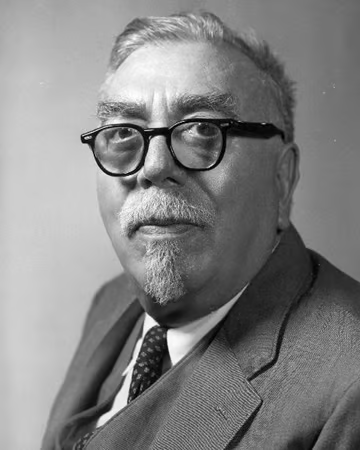
Konrad Jacobs, © MFO, CC BY-SA 2.0 DE, via Wikimedia Commons
Contents
The Education Experiment
Leo Wiener had opinions about learning.
A Harvard professor of Slavic languages who spoke more than a dozen of them, Leo believed that conventional schooling was a catastrophic waste of a child's formative years — too slow, too dull, too focused on rote memorization and social conformity. He had a better idea. He would teach his son himself, from the very beginning, using a method of his own design: intensive, demanding, relentless, and — to put it charitably — unconventional.
Norbert Wiener was born on November 26, 1894, in Columbia, Missouri, the first child of Leo and Bertha Wiener. Within months, Leo had the boy enrolled in his experiment.
The method worked like this: push the child constantly. When the child succeeds, say nothing — that is the baseline. When the child makes an error, correct it sharply, sometimes harshly. Never let the child become comfortable, because comfort is the enemy of growth. Keep raising the bar, always slightly out of reach, so the child is perpetually straining upward.
The results were measurable. Norbert was reading fluently by the age of three. He was consuming natural history texts at six, physics and biology at seven. Leo was not modest about any of this — he documented it extensively, later writing a book called Prodigy: A Psychobiological Study of Genius, in which he essentially claimed credit for manufacturing one.
But the results had another dimension that Leo's book spent less time on. Norbert was socially isolated, clumsy, nearsighted to the point of near-blindness, and plagued by anxiety and self-doubt that would follow him for the rest of his life. He had been, in some fundamental way, optimized for one thing at the expense of everything else.
He entered Tufts University at the age of eleven.
He graduated, with a bachelor's degree in mathematics, at fourteen.
Leo believed conventional schooling was catastrophic — too slow, too dull, too focused on rote memorization. He would teach his son himself.
Harvard, Age Fourteen
The autumn of 1909. A fourteen-year-old with thick glasses, no social skills, and an extraordinary command of abstract mathematics enrolls in Harvard's graduate program in zoology. His father has decided that mathematics alone is too narrow — Norbert needs to be a complete scientist.
It did not go well.
Zoology requires laboratory work. Laboratory work requires fine motor control. Norbert had none. He broke equipment constantly. He struggled to see specimens clearly even through a microscope. After one disastrous year, Leo pivoted: Harvard graduate program in philosophy instead.
Philosophy went better. Norbert was fascinated by mathematical logic — the intersection of formal reasoning and structure where his instincts were sharpest. He worked under the logician Karl Schmidt and became absorbed in the question of whether mathematics could be fully formalized: whether every mathematical truth could, in principle, be proved from a finite set of axioms.
This was not an idle question. It was, in 1910, one of the most important open problems in all of mathematics — the question that would eventually be answered, devastatingly, by Kurt Gödel in 1931.
But Norbert didn't stay in philosophy long either. He was restless, and his restlessness was productive. By 1912, at the age of eighteen, he had completed his PhD. His dissertation was on mathematical logic — specifically, on the relationship between ordered pairs and the foundations of number theory. It was rigorous, original, and correct.
He was, at that moment, the youngest person to have received a Harvard PhD.
Bertrand Russell, who reviewed his early work, called him "the most brilliant young man I have met."
The Wandering Years
The PhD did not open doors. It opened a void.
Wiener was eighteen, catastrophically over-educated for almost any available position, socially underprepared for professional life, and still operating under his father's demanding shadow. He spent the next several years in a kind of productive but painful drift — trying and discarding occupations at a pace that would look, from the outside, like instability but was, from the inside, the systematic rejection of everything that didn't fit.
He went to Cambridge, England, to study with Bertrand Russell and G.H. Hardy. Russell found him difficult — brilliant but argumentative, unable to accept any conclusion he hadn't personally derived. Hardy was more tolerant of strong opinions and pushed Wiener toward analysis, toward the precise formal study of infinite series, integration, and the structure of continuous functions.
Then Göttingen, Germany, to study with David Hilbert — arguably the greatest mathematician alive. The Göttingen experience was transformative: Hilbert's approach, which treated mathematics as a formal game played by explicit rules, gave Wiener the tools he would need years later to do his most important work.
Then back to the United States, where he tried journalism, encyclopedia writing, and a stint as a factory worker (which lasted about a week). He applied for academic positions and received rejections. He worked as a mathematician for the Army during the first months of World War One, calculating ballistics tables — tedious, mechanical computation that nevertheless kept his formal instincts sharp.
Throughout this period, Wiener was struggling with something deeper than career uncertainty. He suffered from severe mood swings, periods of crushing depression followed by bursts of almost manic productivity. He doubted his own abilities obsessively, despite accumulating evidence to the contrary. He was, in modern terms, almost certainly bipolar — a condition that his era didn't name, didn't treat, and didn't accommodate.
In 1919, on the recommendation of several colleagues, MIT offered him a position in the mathematics department. He was twenty-four years old and had already lived several academic lifetimes.
He would stay at MIT for the rest of his career.
He tried journalism, encyclopedia writing, a factory job. He suffered from mood swings and depression. And then MIT offered him a position — and he found his home.
Making Chaos Rigorous: The Wiener Process
By 1920, the scientific community had a problem.
Brownian motion — the ceaseless jitter of microscopic particles suspended in fluid, first documented by Robert Brown in 1827 and explained by Einstein in 1905 — was understood physically. Einstein had shown that the motion was caused by the cumulative effect of enormous numbers of molecular collisions. The mathematics of individual molecules was classical mechanics; the statistics of their aggregate effect was the Gaussian distribution.
But the path of a Brownian particle — the actual trajectory it traces through space over continuous time — was not mathematically well-defined. Einstein's theory told you the probability distribution of where a particle would be after a given time. It did not tell you how to make rigorous sense of the path the particle actually took to get there.
This was not a minor technical gap. It was a foundational problem. You couldn't integrate along a Brownian path because the path was nowhere differentiable — infinitely jagged at every scale, impossible to assign a meaningful tangent line to. The standard tools of calculus, built on smooth curves, simply didn't apply.
Louis Bachelier had used Brownian motion implicitly in his 1900 thesis on financial markets. Einstein had used it physically. Neither had constructed it rigorously as a mathematical object. Neither had proved that such an object — a continuous, infinitely jagged, nowhere-differentiable path — could even exist in a mathematically coherent sense.
Wiener did.
In a series of papers between 1921 and 1923 — culminating in the landmark "Differential-Space" paper of 1923 — Wiener constructed what we now call Wiener measure: a rigorous probability measure on the space of all continuous functions from time to real numbers. This allowed, for the first time, a fully mathematically sound definition of a Brownian path.
The construction was technically daunting, requiring the machinery of measure theory that had only recently been developed by Henri Lebesgue and Émile Borel. Wiener had to prove that you could assign consistent probabilities to infinitely complex sets of continuous functions — that the intuitive idea of "a random continuous path" could be made mathematically precise without contradiction.
He proved it. The object he constructed is now called the Wiener process, and it is one of the most important mathematical objects in all of modern science.
The path of a Brownian particle was nowhere differentiable — infinitely jagged at every scale. Standard calculus simply didn't apply. Wiener proved you could make it rigorous anyway.
What the Wiener Process Actually Is
The formal definition is elegant in its minimalism. A Wiener process is a stochastic process — a family of random variables indexed by continuous time — satisfying four properties:
- Starts at zero: .
- Independent increments: The changes and are independent whenever the time intervals and don't overlap. The future doesn't remember the past.
- Gaussian increments: Each increment follows a normal distribution with mean zero and variance . Bigger time gaps, bigger spread — but the growth is in proportion to , not itself.
- Continuous paths: With probability one, the function is a continuous function of time.
From these four axioms, everything follows. And yet the resulting object is extraordinarily strange. The paths are continuous — they have no jumps — but they are nowhere differentiable. At every single point in time, the rate of change is undefined. The path looks smooth from a distance and is infinitely jagged up close, no matter how close you look.
This was the mathematically rigorous form of what Brown had observed, what Bachelier had intuited, and what Einstein had explained physically. Wiener gave it a proper mathematical home.
And on that foundation, everything else would be built.
The War Upstairs: Targeting the Sky
When the Second World War began, Norbert Wiener was forty-five years old and in the most productive period of his career. He had published foundational work on Brownian motion, on harmonic analysis, on what he was beginning to call "generalized harmonic analysis" — the rigorous extension of Fourier analysis to functions that don't converge in the usual sense.
He wanted to help with the war effort. But he was deeply ambivalent about weapons. He had seen what the First World War had done to Europe, to mathematics, to scientific careers.
The problem that was brought to him seemed, at first, almost purely mathematical.
Anti-aircraft gunnery in 1940 was an increasingly futile exercise. A modern fighter plane flew at speeds that made simple extrapolation useless — you couldn't point a gun where the plane was, you had to predict where it would be. And those predictions had to account for evasive manoeuvring, for noise in the observation equipment, for the random-looking variation in a pilot's flight path.
The military needed a way to predict the future position of an aircraft from a noisy, incomplete, observed trajectory. This was, at its core, a problem in statistics and signal processing.
Wiener attacked it with everything he had.
Working with MIT colleague Julian Bigelow and Mexican physiologist Arturo Rosenblueth, Wiener developed what would become the Wiener filter — a mathematical framework for extracting a true signal from noise, and for using the filtered signal to make optimal predictions about the future. The underlying idea was to use the entire statistical history of observed aircraft trajectories, not just the most recent measurement, to compute the best possible prediction of where the plane would be ten seconds from now.
The resulting classified report, circulated internally in 1942 under the title "The Extrapolation, Interpolation, and Smoothing of Stationary Time Series," was so dense with mathematics that it earned a nickname among military engineers: the Yellow Peril.
Officially, this was due to its yellow cover. Unofficially, it was because reading it was approximately as dangerous as a battlefield.
The Yellow Peril, eventually declassified and published in 1949, became one of the foundational texts of modern signal processing and control theory. Every noise-cancelling headphone, every radar system, every audio codec that strips static from a recording operates on principles that trace directly to Wiener's 1942 wartime report.
Wiener wrote it to shoot down planes. Eighty years later, it helps you sleep on one.
But Wiener noticed something else while building his filter.
The Feedback Loop
In designing a system that could predict and track a moving target, Wiener and his collaborators realized they were building something more general than a gun-pointing mechanism. They were building a system that could observe its environment, compute a desired action, execute that action, observe the result, and use the gap between the desired and actual outcome to correct its next action.
They were building feedback.
Feedback was not a new concept in engineering. Steam engine governors used it. Thermostats used it. But nobody had given it a formal mathematical framework. Nobody had realized that feedback control in machines was structurally identical to homeostasis in living organisms — the way the human body maintains its temperature, its blood sugar, its posture. Nobody had noticed that the same mathematical description covered both.
Wiener, Bigelow, and Rosenblueth noticed. They wrote a paper in 1943, published in the journal Philosophy of Science, titled "Behaviour, Purpose and Teleology," which proposed that purposive, goal-directed behaviour in both machines and animals could be understood through the unified framework of feedback and error correction.
It was one of the most consequential interdisciplinary papers of the twentieth century.
The anti-aircraft predictor taught Wiener something deeper: that feedback control in machines was mathematically identical to homeostasis in living organisms.
Cybernetics: The Science of Control
The 1943 paper was an opening move. The full statement came five years later.
In 1948, Wiener published Cybernetics: Or Control and Communication in the Animal and the Machine. The title introduced a new word, derived from the Greek kubernetes — the helmsman who steers a ship — and proposed a new science: the unified study of control and communication in both engineered systems and living organisms.
The book was a manifesto as much as a scientific treatise. It argued that the behavior of any complex system — biological, mechanical, or social — could be understood in terms of the same basic principles: information, feedback, purpose, and correction. A thermostat, a hand reaching for a glass of water, an economy responding to price signals, and a military missile seeking a target were, at some level of abstraction, all doing the same thing.
The book landed on the world like a depth charge.
Engineers and mathematicians were impressed by its technical chapters. Biologists were startled to find their work described in the language of control theory. Philosophers were alarmed — or exhilarated — by the implication that the boundary between life and machine was blurrier than anyone had assumed. Psychologists saw in feedback the beginning of a mechanistic account of cognition.
Wiener had, almost single-handedly, invented the intellectual framework that would give birth to:
- Control theory and systems engineering
- Information theory (developed simultaneously, and in parallel conversation, by Claude Shannon)
- Cognitive science and the computational theory of mind
- Artificial intelligence — the very word "artificial intelligence" emerged from the cybernetics conversation
- Robotics and autonomous systems
The word "cybernetics" itself was eventually superseded, absorbed into these descendant fields. But the ideas never went away.

MIT Press, Public domain, via Wikimedia Commons
The Prophet Who Worried
Norbert Wiener was not naive about what he had built.
In 1950, he published a follow-up book called The Human Use of Human Beings: Cybernetics and Society. Where Cybernetics was technical, dense, written for scientists and engineers, The Human Use of Human Beings was written for the general public. Its argument was not celebratory.
Wiener's central thesis was both simple and alarming: the machines he had helped to conceptualize — systems that could learn, adapt, and respond to their environment — were going to displace human workers on a massive scale. Not just the manual labour that earlier industrial machines had displaced, but cognitive labour. Skilled labour. Judgment-based labour. The machines would not merely replace muscles; they would replace minds.
This displacement, he argued, would be catastrophic unless society prepared deliberately and carefully for it. The problem was not technology itself — technology was neutral. The problem was the gap between technological capability and social adaptation: the period when the machines could do the job but the institutions that organized human work, education, and economic security hadn't yet caught up.
He was writing this in 1950. The machines that concerned him did not yet exist in any commercially meaningful form. He was describing the early twenty-first century.
Wiener warned in 1950 that intelligent machines would displace not just manual labour but cognitive labour — judgment, skill, creativity. He was describing the world we now live in.
The book also contained something unusual for a scientific text: an ethical stance.
After the Manhattan Project, after the atomic bombs on Hiroshima and Nagasaki, Wiener had made a personal decision. He would refuse to work on military applications. He turned down contracts from the Army, from the Air Force, from institutions he knew were working on weapons. He wrote public letters explaining his position. He was one of the first prominent scientists to articulate the idea that a mathematician's responsibility extended beyond the mathematical correctness of his results to the use those results were put to.
His colleagues mostly disagreed. The Cold War was underway; the Soviet Union had the bomb; scientific talent was a national resource. Wiener's refusal looked, to many of them, like self-indulgence at best and naïveté at worst.
He held his position anyway.
The Mathematics Underneath Everything
For readers following this series — on Monte Carlo methods, stochastic processes, and the mathematics of randomness — Wiener's most direct legacy is technical rather than philosophical.
The Wiener process he constructed in 1923 is the foundation on which modern stochastic calculus is built. In 1944, Japanese mathematician Kiyosi Itô would take the Wiener process as his starting point and develop Itô calculus — a new kind of calculus designed specifically for integration and differentiation along nowhere-differentiable paths. Without the rigorous Wiener process, Itô calculus would have had no foundation.
And without Itô calculus, there is no Black-Scholes-Merton formula for options pricing. There is no Euler-Maruyama method for simulating stochastic differential equations. There is no mathematical framework for the Langevin equation that describes diffusion in physics, or the Cox-Ingersoll-Ross model that describes interest rate evolution in finance, or the geometric Brownian motion that models stock prices.
The chain of dependencies is direct and unavoidable:
Brown (1827) → observation of random motion
Bachelier (1900) → informal use of random walks in finance
Einstein (1905) → physical explanation of Brownian motion
Wiener (1921–1923) → rigorous mathematical construction of the Wiener process
Itô (1944) → calculus on Wiener paths
Black, Scholes, Merton (1973) → options pricing via stochastic PDEs
Euler-Maruyama, Milstein (1955–1974) → numerical simulation of SDEs
Modern Monte Carlo → simulation of everything else
Wiener is the fourth link in that chain, but he is indispensable. Without his 1923 construction, every subsequent step would be building on sand. The Wiener process is not a technique or a tool — it is the foundation, the mathematical object that makes rigorous everything that comes after.
Without Wiener's 1923 construction, Itô calculus has no foundation. Without Itô calculus, there is no Black-Scholes, no SDE simulation, no modern stochastic Monte Carlo.
The Wiener filter — his wartime work on optimal signal extraction — has an equally direct lineage. The Kalman filter (1960), which guides every GPS receiver and spacecraft ever built, is a generalization of the Wiener filter adapted for systems with a known dynamical structure. When your phone tells you your precise location, it is executing an algorithm whose theoretical ancestry runs directly to Wiener's classified 1942 report.
The Strange Last Chapter
In March 1964, Norbert Wiener was in Stockholm to receive the National Medal of Science from President Lyndon Johnson — but he died before the ceremony. He collapsed at a reception at the Royal Swedish Academy of Sciences on March 18, 1964. He was sixty-nine years old.
He died in motion, which seems appropriate. He had spent his entire life somewhere between here and there, between one problem and the next, between mathematics and philosophy, between science and social conscience, between the abstract and the urgently practical.
His personal life had been difficult in ways he was honest about. He had never fully escaped his father's demands — he wrote two autobiographies, and both are haunted by Leo. He suffered from depression throughout his adult life, from the mood swings that made some periods extraordinarily productive and others nearly unbearable. He was not easy to work with, or to know, or to live with.
But he had built things.
He had built the mathematical home for continuous randomness — the Wiener measure on path space that made rigorous everything from Itô calculus to modern machine learning theory. He had built the framework for extracting truth from noise. He had built the conceptual vocabulary for understanding how complex systems maintain purpose — in machines, in organisms, in societies. And he had looked at what he built and asked, publicly and insistently, what it would mean for the humans who would one day have to share the world with it.
The absent-minded professor who couldn't remember which way he'd been walking had, it turned out, been thinking very hard about where everyone was going.
What Comes Next in This Series
This article is part of our Historical Deep Dives series within the broader Monte Carlo and stochastic methods story.
Up next:
- "The Japanese Connection: Itô, Maruyama, and Stochastic Calculus" — How Kiyosi Itô built a new kind of calculus on Wiener's foundations, and why differentiating along a Brownian path requires entirely new rules.
- "The Manhattan Project's Mathematical Legacy" — The computing machines and classified mathematics that emerged from Los Alamos, and the scientists who carried Monte Carlo into every field that followed.
The technical foundations of Wiener's work are explored in:
- When Randomness Met Calculus: A Practitioner's Guide to Stochastic Differential Equations — the Itô calculus framework Wiener's process makes possible
- Bachelier's Revenge: How a Forgotten Thesis Shaped Modern Finance — the parallel story of how the same random walk appeared in finance five years before Einstein
- From Pollen Grains to Nuclear Bombs: The Astonishing Story of Monte Carlo Methods — the full arc from Brown's microscope to the Los Alamos computers
Sources & Further Reading
Primary Sources & Wiener's Own Writings
- Wiener, N. (1923). Differential-Space. Journal of Mathematics and Physics, 2(1–4), 131–174.
- Wiener, N. (1942). The Extrapolation, Interpolation, and Smoothing of Stationary Time Series (classified report; published 1949, MIT Press / Wiley).
- Wiener, N. (1948). Cybernetics: Or Control and Communication in the Animal and the Machine. MIT Press.
- Wiener, N. (1950). The Human Use of Human Beings: Cybernetics and Society. Houghton Mifflin.
- Wiener, N. (1953). Ex-Prodigy: My Childhood and Youth. MIT Press.
- Wiener, N. (1956). I Am a Mathematician: The Later Life of a Prodigy. MIT Press.
- Rosenblueth, A., Wiener, N., & Bigelow, J. (1943). Behaviour, Purpose and Teleology. Philosophy of Science, 10(1), 18–24.
Biographical & Historical
- Conway, F. & Siegelman, J. (2005). Dark Hero of the Information Age: In Search of Norbert Wiener, the Father of Cybernetics. Basic Books.
- Heims, S. J. (1980). John von Neumann and Norbert Wiener: From Mathematics to the Technologies of Life and Death. MIT Press.
- Masani, P. R. (1990). Norbert Wiener 1894–1964. Birkhäuser. (The definitive mathematical biography.)
Mathematical Context
- Itô, K. (1944). Stochastic Integral. Proceedings of the Imperial Academy, 20(8), 519–524.
- Kloeden, P. E. & Platen, E. (1992). Numerical Solution of Stochastic Differential Equations. Springer.
- Karatzas, I. & Shreve, S. E. (1991). Brownian Motion and Stochastic Calculus (2nd ed.). Springer.
Get in Touch
Fascinated by the history of mathematical ideas — or working with stochastic methods in your own field? Want to discuss how Wiener's work connects to modern machine learning, signal processing, or quantitative finance?
Connect with me:
- 📧 Email: [email protected]
- 🐦 Twitter/X: @TheDataGuyPro
- 💼 LinkedIn: Muhammad Afzaal
- 💻 GitHub: @mafzaal
- 🎥 YouTube: @TheDataGuyPro
- 🎧 Podcast: TheDataGuy Show
Whether you're building quantitative models, learning stochastic calculus, or just drawn to the stories of the people who built the mathematical infrastructure we all use — I'd love to hear from you. The most interesting conversations happen at the edges of fields. Wiener lived there his whole life.