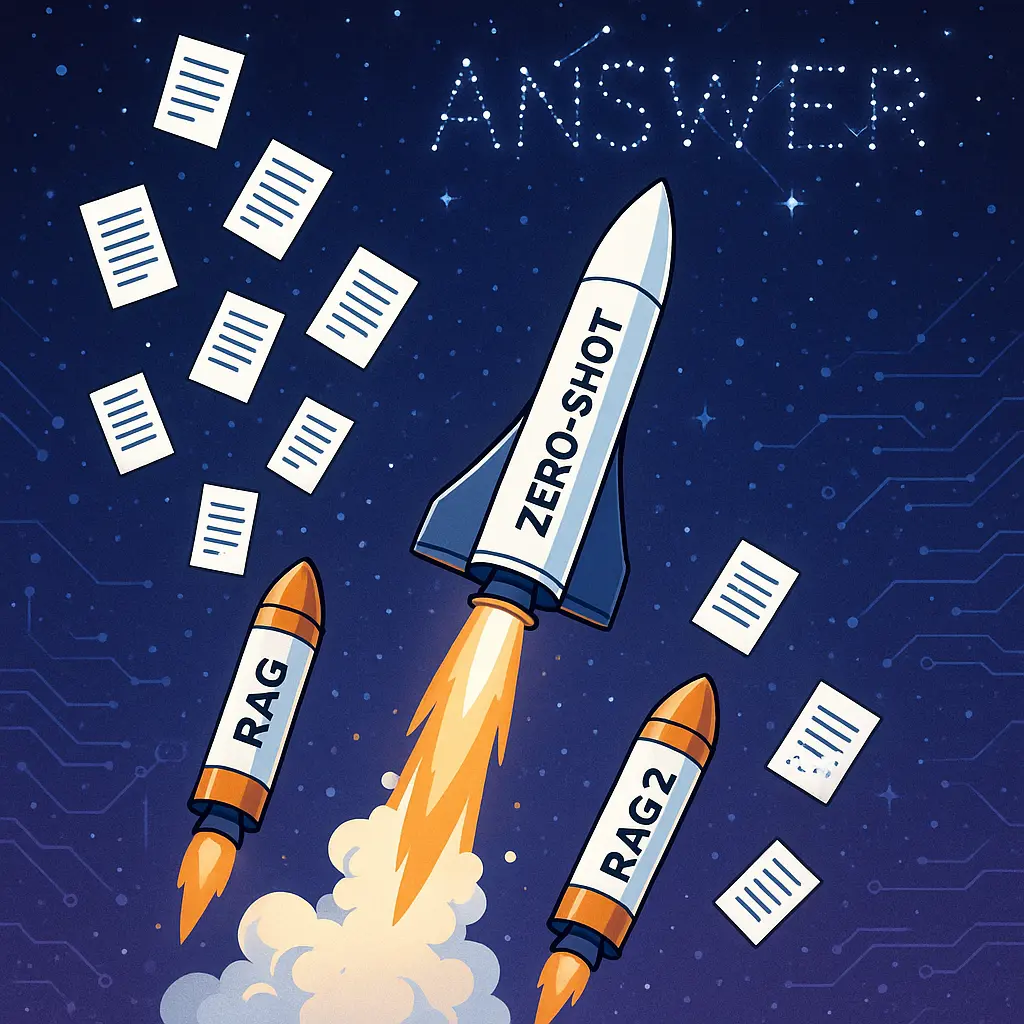
Zero-Shot RAG: Building Systems That Work Out-of-the-Box
Introduction: The Promise of Zero-Shot RAG
When building AI systems powered by Large Language Models (LLMs), there's often significant friction between conceptualizing a solution and deploying one that actually works in production. Retrieval-Augmented Generation (RAG) systems, which enhance LLM outputs with context from external knowledge sources, typically require multiple iterations of fine-tuning to achieve acceptable performance.
But what if you could build RAG systems that work effectively right out of the box—with minimal custom tuning?
In this post, I'll explore techniques for creating "zero-shot RAG" systems: solutions that perform well immediately, allowing you to rapidly deploy functional AI applications without extensive prompt engineering, parameter tuning, or model fine-tuning.
Contents
The Zero-Shot Advantage
Unlike traditional RAG implementations that might require:
- Extensive prompt engineering
- Custom retrieval thresholds
- Fine-tuned embedding models
- Specialized re-ranking systems
- Domain-specific response formats
Zero-shot RAG aims to leverage the inherent capabilities of modern LLMs and embedding models to perform well across diverse domains and query types with minimal configuration.
The key benefits include:
- Faster time-to-market for AI applications
- Reduced development overhead and engineering costs
- Simplified maintenance with fewer custom components
- Greater adaptability to changing information needs
Key Components of Effective Zero-Shot RAG
1. Choosing the Right Foundation Models
The selection of base models dramatically impacts zero-shot performance. For truly effective zero-shot RAG systems, consider:
Embedding Models
Modern embedding models like OpenAI's text-embedding-3-large or Cohere's embed-english-v3.0 demonstrate remarkably consistent zero-shot retrieval performance across domains. These models understand conceptual relationships that earlier models missed.
from openai import OpenAI

client = OpenAI()

def get_embeddings(texts, model="text-embedding-3-large"):
    response = client.embeddings.create(
        input=texts,
        model=model
    )
    return [embedding.embedding for embedding in response.data]
LLM Selection
Models with strong reasoning capabilities and instruction-following behavior perform better in zero-shot RAG scenarios. Claude 3.7 Sonnet, GPT-4o, and similar models demonstrate excellent ability to integrate retrieved content without explicit instructions.
2. Document Processing Strategies
Zero-shot RAG performance significantly depends on how source documents are processed:
Chunking That Preserves Context
Rather than arbitrary character-count chunking, use semantic chunking that maintains context and meaning:
def semantic_chunking(document):
    # Use natural boundaries like paragraphs, sections, or semantic units
    sections = []

    # Split by major section boundaries first
    major_sections = document.split("\n## ")

    for section in major_sections:
        # Further split into logical units like paragraphs
        paragraphs = section.split("\n\n")
        sections.extend(paragraphs)

    # Filter out very short sections and ensure meaningful content
    return [s for s in sections if len(s.split()) > 30]
Metadata Enrichment
Automatic metadata extraction helps retrieval without custom indices:
def extract_metadata(chunk):
    # Extract key metadata that helps with retrieval relevance
    return {
        "content_type": identify_content_type(chunk),
        "key_entities": extract_entities(chunk),
        "timestamp": extract_dates(chunk),
        "summary": generate_summary(chunk)
    }
3. Universal Retrieval Patterns
The retrieval approach dramatically impacts zero-shot performance:
Hybrid Search
Combining semantic and keyword-based retrieval creates more robust zero-shot performance:
def hybrid_search(query, documents, weights=(0.7, 0.3)):
    # Perform semantic search
    semantic_results = semantic_search(query, documents)

    # Perform keyword search
    keyword_results = keyword_search(query, documents)

    # Combine results with weighted scoring
    combined_results = {}
    for doc_id, score in semantic_results.items():
        combined_results[doc_id] = score * weights[0]

    for doc_id, score in keyword_results.items():
        combined_results[doc_id] = combined_results.get(doc_id, 0) + score * weights[1]

    return sorted(combined_results.items(), key=lambda x: x[1], reverse=True)
Query Transformation
Automatically expanding queries improves retrieval without manual tuning:
def transform_query(original_query, llm_client):
    prompt = f"""Given the user's query: "{original_query}"
    Generate three alternative phrasings of this query to improve retrieval.
    These should capture different semantic aspects of the query.
    Return only the three alternative queries, one per line."""

    response = llm_client.chat.completions.create(
        model="gpt-4o",
        messages=[{"role": "user", "content": prompt}]
    )

    alternatives = response.choices[0].message.content.strip().split("\n")
    return [original_query] + alternatives
Putting It All Together: A Zero-Shot RAG Architecture
Here's how these components fit together in a complete zero-shot RAG system:
class ZeroShotRAG:
    def __init__(self, documents, embedding_model="text-embedding-3-large", llm_model="gpt-4o"):
        self.embedding_model = embedding_model
        self.llm_model = llm_model

        # Process documents with semantic chunking
        self.chunks = []
        for doc in documents:
            self.chunks.extend(semantic_chunking(doc))

        # Enrich chunks with metadata
        self.enriched_chunks = [
            {"content": chunk, "metadata": extract_metadata(chunk)}
            for chunk in self.chunks
        ]

        # Create embeddings for all chunks
        self.chunk_embeddings = get_embeddings(
            [chunk["content"] for chunk in self.enriched_chunks],
            model=self.embedding_model
        )

        # Initialize clients
        self.openai_client = OpenAI()

    def answer_query(self, query):
        # Transform query for better retrieval
        expanded_queries = transform_query(query, self.openai_client)

        # Get embeddings for all query versions
        query_embeddings = get_embeddings(expanded_queries, model=self.embedding_model)

        # Perform hybrid retrieval
        relevant_chunks = self.retrieve_relevant_chunks(expanded_queries, query_embeddings)

        # Generate response using retrieved context
        response = self.generate_response(query, relevant_chunks)

        return response

    def retrieve_relevant_chunks(self, queries, query_embeddings):
        # Perform retrieval using a combination of semantic and keyword similarity
        results = []

        # Calculate cosine similarity for semantic search
        for query_idx, query in enumerate(queries):
            query_embedding = query_embeddings[query_idx]

            for chunk_idx, chunk_embedding in enumerate(self.chunk_embeddings):
            # Compute cosine similarity between query and chunk embeddings
            dot_product = sum(q * c for q, c in zip(query_embedding, chunk_embedding))
            query_norm = (sum(q * q for q in query_embedding)) ** 0.5
            chunk_norm = (sum(c * c for c in chunk_embedding)) ** 0.5

            # Avoid division by zero
            if query_norm > 0 and chunk_norm > 0:
                cosine_similarity = dot_product / (query_norm * chunk_norm)
            else:
                cosine_similarity = 0

            # Add keyword-based similarity
            keyword_score = self.calculate_keyword_score(query, self.enriched_chunks[chunk_idx]["content"])

            # Weighted combination (70% semantic, 30% keyword)
            combined_score = 0.7 * cosine_similarity + 0.3 * keyword_score

            results.append((chunk_idx, combined_score))

        # Aggregate scores across all query variations
        chunk_scores = {}
        for chunk_idx, score in results:
            if chunk_idx not in chunk_scores or score > chunk_scores[chunk_idx]:
            chunk_scores[chunk_idx] = score

        # Return top chunks
        top_indices = sorted(chunk_scores.keys(), key=lambda idx: chunk_scores[idx], reverse=True)[:5]
        return [self.enriched_chunks[idx] for idx in top_indices]

        def calculate_keyword_score(self, query, chunk_text):
            # Simple keyword-based scoring using term frequency
            query_terms = set(query.lower().split())
            chunk_terms = chunk_text.lower().split()

            # Count matching terms
            matches = sum(1 for term in chunk_terms if term in query_terms)

            # Normalize by chunk length to avoid favoring longer chunks
            return matches / (len(chunk_terms) + 1) if chunk_terms else 0
    def generate_response(self, query, context_chunks):
        # Format context and query for the LLM
        prompt = self.format_prompt(query, context_chunks)

        # Generate response
        response = self.openai_client.chat.completions.create(
            model=self.llm_model,
            messages=[
                {"role": "system", "content": "You are a helpful assistant that answers based on the provided context."},
                {"role": "user", "content": prompt}
            ]
        )

        return response.choices[0].message.content

    def format_prompt(self, query, context_chunks):
        context_str = "\n\n".join([chunk["content"] for chunk in context_chunks])

        return f"""Please answer the following question based on the context provided below.
        If the answer cannot be found in the context, say 'I don't have enough information to answer this question.'

        CONTEXT:
        {context_str}

        QUESTION:
        {query}
        """
Real-World Zero-Shot RAG: The Let's Talk Example
To ground these concepts, let's look at Let's Talk — an open-source, plug-and-play chat widget that brings zero-shot RAG to any website or blog. You can try it live at TheDataGuy.PRO (bottom-right corner).
Let's Talk is designed to work out-of-the-box, requiring minimal configuration to deliver high-quality, context-aware answers. Its architecture embodies the zero-shot RAG principles discussed above:
- Indexing Flow: Ingests content from file systems or web crawls, extracts metadata, and uses semantic chunking for context-preserving document splits. Embeddings are generated (e.g., with Snowflake Arctic Embed) and stored in a vector database (Qdrant).
- Query/Response Flow: Uses a ReAct agent with hybrid retrieval (BM25, multi-query, vector search) and ensemble weighting. The backend is built with Python, FastAPI, LangChain, and LangGraph, while the frontend is a modern Svelte component.
Let's Talk Architecture Overview
Read or watch Let's Talk Architecture Overview
How Let's Talk Implements Zero-Shot RAG Principles
| Principle | Let's Talk Implementation |
|---|---|
| Minimal Tuning | Works out-of-the-box, no prompt engineering required |
| Hybrid Retrieval | Combines BM25, multi-query, and vector search |
| Semantic Chunking | Uses recursive and semantic chunking for context preservation |
| Metadata Enrichment | Extracts and stores metadata for better retrieval |
| LLM Flexibility | Supports any LLM via LangChain APIs |
| Open Source & Modular | Svelte frontend, Python backend, Dockerized for easy deploy |
Try It Yourself
- Live Demo: TheDataGuy.PRO
- Source Code: github.com/mafzaal/lets-talk
Zero-Shot vs. Fine-Tuning: When Each Approach Shines
In my previous posts about data strategy, I emphasized the value of fine-tuning models on proprietary data. Zero-shot RAG doesn't replace this approach—they serve different purposes:
| Zero-Shot RAG | Fine-Tuned Approaches |
|---|---|
| ✅ Faster time-to-market | ✅ Higher performance ceiling |
| ✅ Lower development costs | ✅ Better for specialized domains |
| ✅ Easier maintenance | ✅ Protected IP/competitive advantage |
| ✅ Flexible across domains | ✅ More consistent outputs |
| ❌ May not capture domain nuances | ❌ Higher development overhead |
| ❌ Less controllable outputs | ❌ Less adaptable to new information |
Evaluating Zero-Shot RAG Performance
How do you know if your zero-shot RAG system is performing well? I recommend using the RAGAS framework I've covered in previous posts to evaluate:
- Retrieval Quality: Are the right documents being retrieved?
- Answer Relevance: Does the answer directly address the query?
- Groundedness: Is the answer fully supported by the retrieved context?
- Contextual Precision: Is the system using only relevant parts of the retrieved documents?
Conclusion: The Path Forward
Zero-shot RAG doesn't eliminate the need for tuning and optimization, but open-source projects like Let's Talk show how far you can go with modular, out-of-the-box architectures. By leveraging modern embedding models, hybrid retrieval, and flexible orchestration, you can deploy powerful RAG systems with minimal effort—and then iterate as needed.
For organizations and developers, the lesson is clear: start with a robust zero-shot baseline, then optimize where it matters most. And if you want to see these ideas in action, check out Let's Talk or contribute to the project!