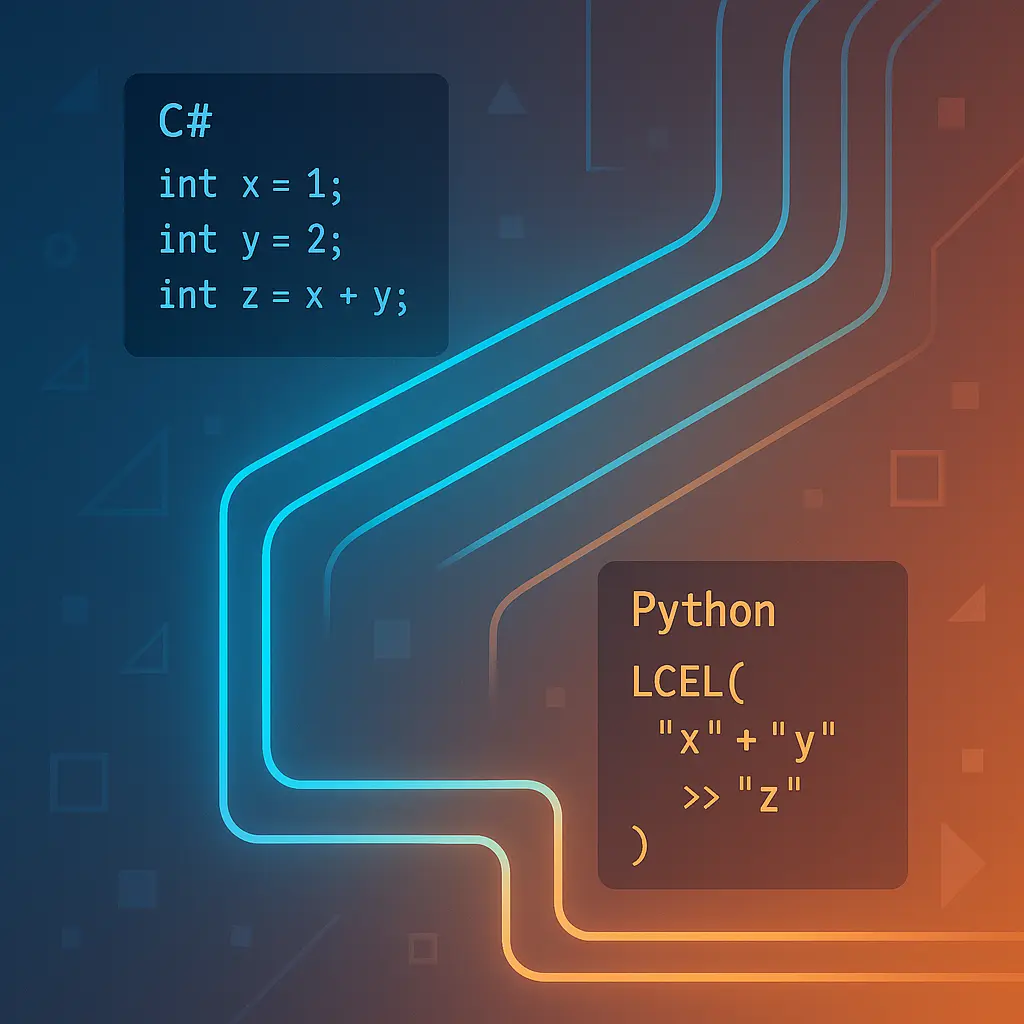
A C# Programmer's Perspective on LangChain Expression Language
As a C# developer diving into LangChain Expression Language (LCEL), I've encountered both challenges and pleasant surprises. Here's what stood out most during my transition.
The Pipe Operator Abstraction Challenge
In C#, processing pipelines are explicit:
var result = inputData
    .Where(item => item.IsValid)
    .Select(item => TransformItem(item))
    .ToList()
    .ForEach(item => ProcessItem(item));
LCEL's pipe operator creates a different flow:
chain = (
    ChatPromptTemplate.from_messages([
        ("system", "You are a helpful assistant specialized in {topic}."),
        ("human", "{query}")
    ])
    | ChatOpenAI(temperature=0.7)
    | (lambda llm_result: llm_result.content)
    | (lambda content: content.split("\n"))
    | (lambda lines: [line for line in lines if line.strip()])
    | (lambda filtered_lines: "\n".join(filtered_lines))
)
With complex chains, questions arise:
- What exactly passes through each step?
- How can I inspect intermediate results?
- How do I debug unexpected outcomes?
This becomes more apparent in real-world examples:
retrieval_chain = (
    {"query": RunnablePassthrough(), "context": retriever | format_docs}
    | prompt
    | llm
    | StrOutputParser()
)
Surprisingly Simple Parallel Execution
Despite abstraction challenges, LCEL handles parallel execution elegantly.
In C#:
var task1 = Task.Run(() => ProcessData(data1));
var task2 = Task.Run(() => ProcessData(data2));
var task3 = Task.Run(() => ProcessData(data3));

await Task.WhenAll(task1, task2, task3);
var results = new[] { task1.Result, task2.Result, task3.Result };
In LCEL:
parallel_chain = RunnableMap({
    "summary": prompt_summary | llm | StrOutputParser(),
    "translation": prompt_translate | llm | StrOutputParser(),
    "analysis": prompt_analyze | llm | StrOutputParser()
})

result = parallel_chain.invoke({"input": user_query})
This approach eliminates manual task management, handling everything behind the scenes.
Best Practices I've Adopted
To balance LCEL's expressiveness with clarity:
- Break complex chains into named subcomponents
- Comment non-obvious transformations
- Create visualization helpers for debugging
- Embrace functional thinking
Conclusion
For C# developers exploring LCEL, approach it with an open mind. The initial learning curve is worth it, especially for AI workflows where LCEL's parallel execution shines.
Want to see these concepts in practice? Check out my Pythonic RAG repository for working examples.
If you found this useful or have questions about transitioning from C# to LCEL, feel free to reach out — we’d love to help!